

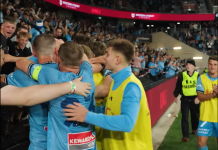





The noticeably increasing average age of squads in the A-League Men this season has left many up-and-coming players with limited opportunities.
A staggering 3-0 loss for Melbourne Victory at the hands of a rampant Perth Glory team on Sunday capped off an eventful third round of the 2021/22 A-League Men season.
The shock defeat at AAMI Park was the Victorian side’s first under newly-appointed head coach Tony Popovic. However, it was not the result itself that appeared to be the leading topic of discussion at the culmination of the round.
On Monday afternoon, one Twitter user was quick to identify a glowingly obvious trend in the competition, only solidified by the starting 11 in which the Victory fielded on Sunday night.
Righto enough is enough. We need legislation mandating one starting 11 player in every @aleaguemen match be under 21 yrs old.
I’ve never been an advocate of the past but it’s needed to save the game in 🇦🇺.
We are not seeing enough talents get the opportunity to play.— John Grimaud 🇦🇺⚽️ (@grimaud_john) December 6, 2021
Upon consideration of the team line-ups over the weekend, there is a substantial element of truth to Grimaud’s assessment. Of the 11 Victory players who started against the Glory on Sunday, eight of them were over the age of 28, which incidentally, was also the average age of the entire 18-man Victory squad.
Despite being the second-highest average age of an ALM matchday squad this season, it was not where the alarming statistic ended in round three.
Sydney FC, Western Sydney Wanderers and Western United all fielded teams with an average age of over 27 in their respective games across the weekend, accentuating the growing tendency of ALM coaches to conservatively select veteran players in favour of exciting young talent.
By doing so, the coaches are sorely missing the mark, in regard to the pertinent role that the league has played in Australian football since its very first season.
With the repeatedly discussed promotion-and-relegation system yet to materialise across the A-Leagues, the ALM has and should continue to exist as a platform to foster the growth of young players without the possibility of relegation, as well as providing them with the opportunity to play professional first division football; an unachievable feat in Australia before the league’s inception back in 2004.
It is no secret that historically, many players who have made their professional debut at A-League Men level have gone on to achieve great success at international level and in the European top flight.
Central Coast Mariners alone have previously nurtured the talents of Socceroos captain Maty Ryan, who made 121 Premier League appearances for Brighton & Hove Albion, as well as fellow Socceroo Trent Sainsbury, and former Crystal Palace and Socceroos captain, Mile Jedinak.
Similarly, Adelaide United’s handing of senior debuts to 17-year-old Awer Mabil and 15-year-old Mohamed Toure, in 2013 and 2020 respectively, were risks that ultimately paid off, as both offered resounding evidence as to what these young players can potentially achieve once provided with the opportunity to play substantial minutes in the ALM.
Toure became the youngest goalscorer in A-League Men history in February 2020, netting against the Mariners in just his second league appearance, while Mabil has since made 116 appearances for Danish first-division side FC Midtjylland, which included a couple of outings against Liverpool in the UEFA Champions League last season.
During the 2015/16 season, Football Federation Australia squandered a golden opportunity to showcase the talent of young players across the competition, after turning on an initial proposal to reduce their quota of five visa players per ALM club to four, following widespread criticism of the ruling.
Whilst the backflip seemed like a good idea at the time, the waning match attendances and arguably, relevancy of the current A-League Men season leaves the competition with a lot to be desired in its current state. Particularly, in consideration of the severe lack of opportunity for its young players; one that could have presented itself six years ago, had the FFA simply turned the other way.
Feature Image Credit: Ngau Kai Yan
Statistics sourced from Ultimate A-League and Soccerway
Enjoy this content? Support The Football Sack
Due in part to COVID and lack of current sponsorship we are at risk of not having the funds to continue running The Football Sack. If you enjoy our content and support our work in training talented young writers, please support us with a donation. If every reader contributed just $3, our funding would be covered for over ten years.
| DONATE |

